Economic Case Study - Counter Strike
This case study will focus on the economic conditions of the video game Counter Strike, which has fascinated me for a long time as a casual player, competitive player, and fan of Counter Strike as an eSport. Counter Strike is unique from other video games, virtual markets, and eSports in its transparency, credibility, and ingenuity, accomplished through three main levers: the game itself (Counter Strike), its developer (Valve), and its infrastructure/platform (Steam). Valve is the game developer of Counter Strike and Steam is a gaming hub created by Valve that has flourished and become the home of PC gaming worldwide. This case study seeks to answer the question, what macroeconomic factors have allowed for Counter Strike to become more economically viable, lucrative, and self-reliant than other video games, eSports, and non-fungible token markets?
Counter Strike can be played both casually or as a competitive video game, or “eSport”, and experiences significant investment from investors, advertisers, professional and casual players, tournament organizers, news sites, eSport organizations, viewers, and beyond. A research article describes the impact of the real-world economy on Counter Strike, and vice versa, as, “External influences further contribute to price fluctuations, particularly the impact of e-sports events and developer updates… Championship victories often drive demand for related skins, while game updates introduce exogenous shocks that significantly alter market valuations” (Perez, M, 2017). Counter Strike, the platform Steam, and the developer Valve have a massive impact on the real-world economy, both as a proof-of-concept as a use case for non-fungible tokens, as a microcosm of a self-sustaining community economy created around a video game. Counter Strike works as a model for the potential financial value of a successful eSport with laissez-faire principles favored over a franchising model. The eSport scene and the speculative skin market community in Counter Strike are tied together through the sticker system, which allows for players and viewers to buy stickers of their favorite eSport teams and professional players for cosmetic use and for speculative investment. The sticker system supports the eSport scene through a shared-revenue mechanism that pays eSport teams a percentage of total sticker sales for any Majors they qualify for. Essentially, Counter Strike is synonymous to an international sports market like soccer, with organizations seeking to qualify for, compete in, and win third-party tournaments for both the raw cash prizes offered and in order to acquire the most lucrative prize: qualification for a Major and getting both organization stickers and player autograph stickers into the game. Per Esports Insider, “In August 2022, Valve revealed that “over the past 12 months alone, we’ve seen […] massive community support with over $70 million raised for professional organisations, teams, and players” (Esports Insider, 2025). Other eSport developers like Riot (Valorant, League of Legends) and Blizzard (Overwatch) instead use a franchise system that requires organizations to pay massive entry fees to be selected as a partner team that competes in a closed-circuit league and tournament system with other franchise teams, and lack the foundational infrastructure and economic interest that a platform like Steam enables Counter Strike to have in order to support an “open circuit” system, making them less profitable with less investment opportunities.
The video game Counter Strike and the platform it’s played on, Steam, operate a virtual market with a scarcity-based economy. Steam is an application developed by Valve that serves as a PC gaming hub, market, and social platform that hosts both its own games and third-party games, and functions as a community market based around tradeable non-fungible tokens. Valve has attained the position of both a pioneer in this space and a highly credible, trustworthy, and laissez-faire developer due to a history of critically acclaimed video games and software developments. The core of the Counter Strike market is based around the infrastructure provided by Steam to facilitate a virtual exchange market and a supply-demand chain/soft gambling system that allow players to receive weapon skins by opening cases. Weapon skins are playable non-fungible tokens that come in different qualities, rarities, and conditions. Cases are received by playing the game and can be sold on the community market for cash directly or opened to receive a random weapon skin from that case collection. Cases and weapon skins are recieved weekly through the drop pool, which rewards players with one random case and one random weapon from the current pool of available skins/cases. The designs for weapon skins are created by community artists, who receive massive amounts of compensation for their work if their designs are selected to be added to the game by Valve. After someone playing Counter Strike receives a skin by opening cases, they can keep them to play with, speculatively hold them in expectation of the skin accruing value, or sell them for cash on the community market. Steam takes marginal transaction fees from the community market, aggregating profit over time. Per an electronic commerce research article published on Springer, “The valuation of CS2 skins is influenced by multiple factors, with artificial scarcity playing a dominant role… In addition to scarcity, cosmetic appeal introduces a subjective dimension to pricing, as buyer preferences for particular patterns and wear conditions can create price variations for identical skin types” (Guede-Fernández et al., 2025). Essentially, weapon skins act in the same way that non-fungible tokens (NFTs) do, but have become a more powerful economic force due to the ability to actually play in-game with your NFTs and the amount of trust and credibility that Valve have built up in Steam’s community market. Another research article summarizes this growing, lucrative phenomenon as, “The Counter-Strike 2 (CS2) skin market has emerged as a sophisticated digital asset exchange, presenting opportunities for algorithmic trading systems. Unlike traditional financial markets, which rely on centralized exchanges and order books, CS2 skins are traded through peer-to-peer transactions. The CS2 skin market, with an estimated valuation of $4.1 billion as of February 2025, operates within a framework that blends elements of collectibles markets and financial derivatives…” (D’Anastasio, C, 2025). In short, the Counter Strike virtual market has come to function as a lucrative and highly speculative exchange for weapon skins as non-fungible token assets.
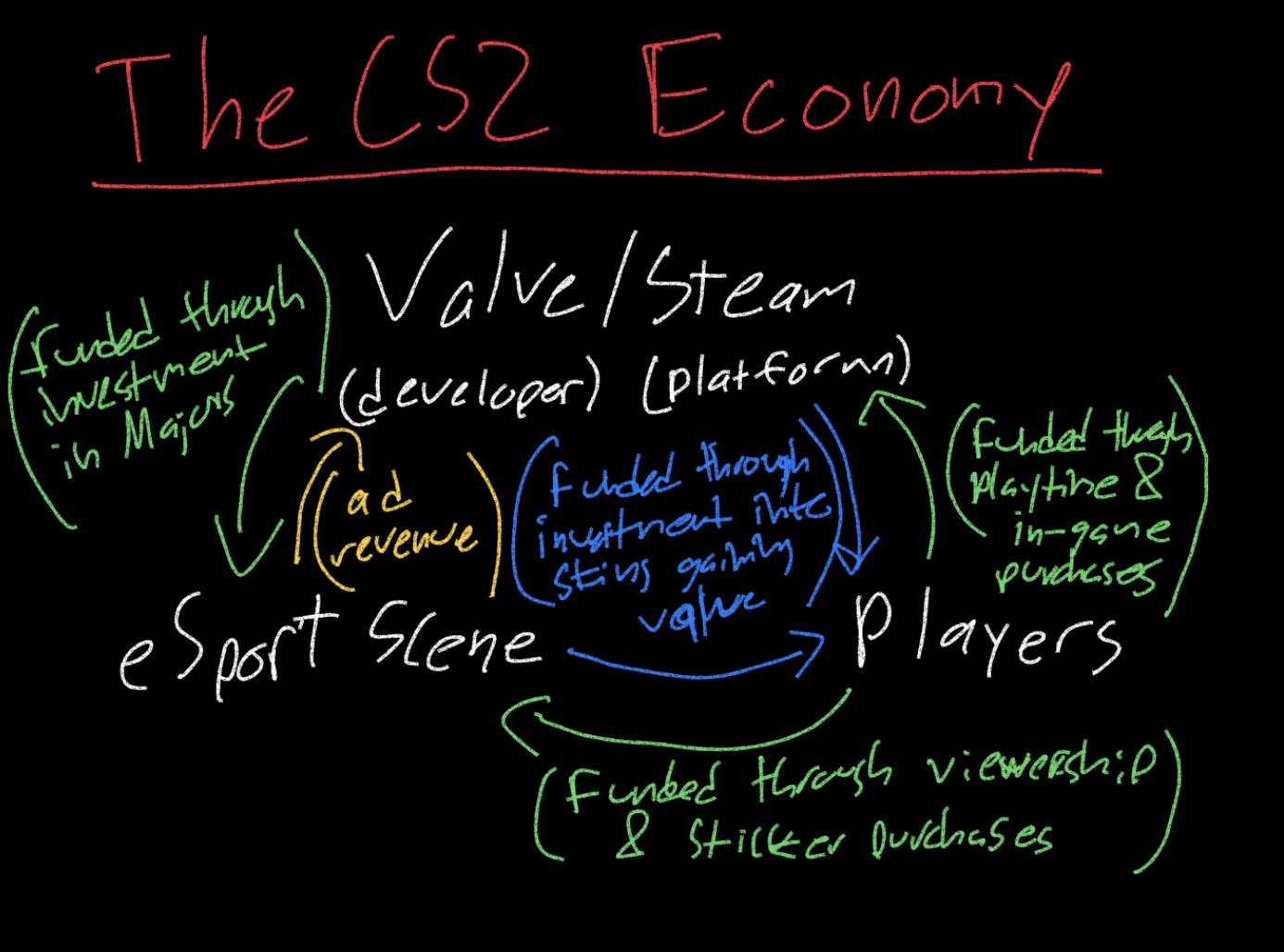
In conclusion, the three main levers involved - the game Counter Strike, the platform Steam that hosts it and makes its virtual economy possible, and the developer Valve and its transparent, laissez-faire nature - all work in tandem to create a self-reliant and self-sustaining virtual economy that ties the eSports scene of the game and the casual playerbase of the game together. Counter Strike serves as the flagship model for what a successful eSport and, more generally, live-service video game economy can look like under ideal conditions..The economic success of Counter Strike can and already has changed the eSports and NFT industries through the proven concept of a digital community market that works. Counter Strike is, and will continue to be, the model for all eSports and video games for how an eSport can mirror the financial success of global sports like soccer, so long as it remains faithful to the core tenets that built its economic success: developer transparency, community trust, and player functionality.
Works Cited Perez, M. (2017). The Top 10 “Counter-Strike: Global Offensive” Esports Teams Won A Total Of $7.7 Million In 2016. Forbes.Com, 1.
Federico Guede-Fernández, Yash Wagle, Pedro Dias, Ana Paula Giordano, Lúcio Henriques, Gonçalo Costa, & Salomé Azevedo. (2025). Artificial intelligence for algorithmic kl,,[]’= trading digital assets: evidence from the Counter-Strike 2 skin market. Frontiers in Artificial Intelligence, 8. https://doi.org/10.3389/frai.2025.1702924
D’Anastasio, C. (2025). Market for ‘Counter-Strike 2’Digital Items Hits New High. Bloomberg.[Google Scholar].
How much is sticker money worth to Counter-Strike teams? (n.d.). https://esportsinsider.com/2024/01/counter-strike-sticker-money-value